NG SHAO KANG


Luna Lake
Luna Lake, a Fishing Simulation Game that I worked on for my second-year game project in university. The goal of the game is to catch the boss fish, The Moonlight Manta. To do so, players will have to catch as many fish as possible to strengthen themselves so that they will be able to reach the final boss. As time progresses, the quality and hence difficulty of fish will also increase.
For this project, I was the Product Manager, Art Lead and Balancing and Level Design Champion. This project pushed me to think outside of the box when it comes to designing levels. The levels in this project are instead waves rather than the conventional thought of what a level might be.
Gameplay loop
Players can move left and right in the game and once they are in a spot where they feel they will be able to catch the fish they want, they can cast their rod. If a fish latches on the bait, they will begin a minigame.
The image below will describe how the minigame is played.


Initial Level Design and Progression
Initially, we had 3 different levels, where each level was a different state of the moon, New Moon, Half Moon and Full Moon, where the boss fish, the Moonlight Manta, would spawn. And in each level, different groups of fish will spawn for the players to catch.
For the first stage, players are only given a basic rod, and in the later 2 stages, players can then choose between the 2 rods.


However, we faced an issue when we started playtesting sessions, where all players would only pick the hook rod to make it easier to catch all the fish (as the minigame becomes easier). This made us rethink how we would move forward from here.
Many feedback also said that only having to catch fishes constantly is fun for the first few minutes, but the hype dies down after the second level and the game just becomes repetitive.
Another feedback we received from our lecturer was that the stages were redundant as we could simplify the Levels into different waves that spawn over time.
Single Level, Many Waves
In our next iteration, we scraped the different levels and changed them into waves of fish instead. So now, every minute, a new school of fish will spawn in with the old ones despawning. We've also adjusted it to make it so that the types of fish we spawn are all based on the number of fishes that the player has already caught.
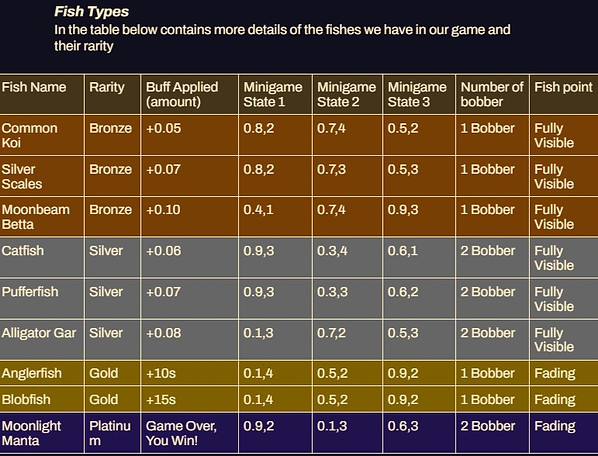


We also removed the rod types completely in favour of granting the fishes a slightly larger amount of buff, this would then clear out the dominant strategy of only using the Hook rod to make it easier to clear the minigame. Along with adding in more variables such as increasing the number of minigame bobber the player has to control simultaneously and if the fish points of those bobbers are fading or not.
These changes helped to improve the overall design of the game and made it more fun and interactive for the players. And with the addition of challenges such as the multiple bobber and visibility of fish points, we also managed to tackle the issue of the game being too repetitive after a while.
Overview and Reflections
Overall, this project has shown me that level design can come in different ways and shapes, and not just in platformer games like Super Mario World. This project has also taught me how to avoid creating dominant strategies in games.